
Closed Captions vs. Subtitles: What’s the Difference?
Estimated Reading Time: 9 Minutes
Last Updated: June 2026
Quick Summary
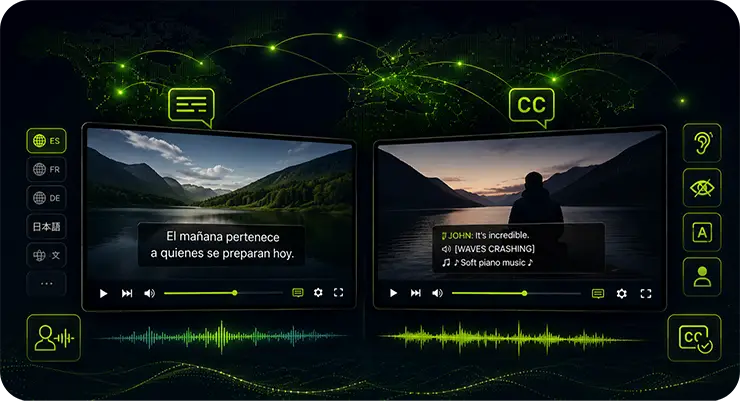
Although the terms closed captions and subtitles are often used interchangeably, they serve different purposes. Subtitles primarily translate or display spoken dialogue, while closed captions provide a complete text representation of both speech and meaningful audio elements such as music, sound effects, and speaker identification. Understanding the difference helps businesses, broadcasters, educators, and content creators deliver accessible and engaging video experiences.
Introduction
Video has become the preferred way for businesses, educators, streaming platforms, and marketers to communicate with their audiences. Whether you’re publishing content on YouTube, Netflix, an internal learning platform, or a corporate website, making that content understandable and accessible is no longer optional.
One of the most common questions production teams ask is whether they need subtitles or closed captions. While both display text on screen, they are designed for different audiences and solve different problems.
Choosing the right option improves accessibility, supports international distribution, enhances the viewer experience, and helps your content meet platform and compliance requirements.
This guide explains the differences in simple terms while exploring when to use each, how they benefit your audience, and what professional organizations should consider before publishing video content.
What Are Subtitles?
Subtitles are on-screen text that represents spoken dialogue. Their primary purpose is to help viewers understand conversations when they cannot understand the language being spoken or prefer to read along while watching.
Unlike captions, subtitles generally assume that the audience can hear the video’s audio. Because of this, they usually do not include descriptions of sound effects, background noises, or music.
Imagine watching a French documentary with English subtitles. The dialogue is translated into English, allowing international audiences to follow the story while still hearing the original narration and voices.
Subtitles are commonly used for:
• International films
• Television series
• Streaming platforms
• YouTube videos
• Online courses
• Marketing campaigns
• Corporate presentations
Professional subtitle production focuses on much more than translation. Editors carefully synchronize dialogue, break lines naturally, maintain comfortable reading speeds, and ensure every subtitle feels like a seamless part of the viewing experience.
What Are Closed Captions?
Closed captions provide a complete textual representation of everything a viewer needs to understand the audio. In addition to spoken dialogue, they include meaningful sound information that cannot be understood through subtitles alone.
This makes closed captions an essential accessibility feature for viewers who are deaf or hard of hearing.
Closed captions may include:
• Speaker identification
• Sound effects
• Background noises
• Music descriptions
• Emotional cues
• Environmental sounds
For example, instead of simply displaying dialogue, professional captions may appear like this:
| Closed Caption Example |
| [Soft piano music begins] |
| Sarah: I think we’re finally here. |
| [Door slowly creaks open] |
| [Thunder rumbling in the distance] |
Unlike open captions, closed captions can usually be turned on or off by the viewer depending on the platform being used.
Closed Captions vs. Subtitles: The Key Differences
Although they look similar on screen, their objectives are quite different.
| Feature | Subtitles | Closed Captions |
|---|---|---|
| Display spoken dialogue | ✔ | ✔ |
| Translate dialogue | ✔ | Sometimes |
| Include sound effects | ✘ | ✔ |
| Include music descriptions | ✘ | ✔ |
| Speaker identification | Usually No | ✔ |
| Accessibility focused | Limited | ✔ |
| Designed for multilingual audiences | ✔ | Sometimes |
The simplest way to remember the difference is this:
Subtitles help viewers understand speech.
Closed captions help viewers understand everything they cannot hear.
When Should You Use Subtitles?
Subtitles are the right choice whenever your goal is to make spoken dialogue understandable for viewers who speak a different language or prefer reading along with the audio.
Businesses frequently use subtitles to expand into international markets without recreating their entire video library. Instead of producing multiple versions of the same video, professionally localized subtitles allow one piece of content to reach audiences across many regions while preserving the original voice and presentation.
Professional subtitles are ideal for:
• International marketing campaigns
• Product demonstrations
• Corporate communications
• E-learning content
• Documentaries
• Feature films
• Social media videos
• Streaming services
When Should You Use Closed Captions?
Closed captions are designed to make video content fully accessible by representing both spoken dialogue and meaningful audio elements. They are particularly important for viewers who are deaf or hard of hearing, but they also benefit many other audiences who watch videos without sound.
With the growing popularity of mobile viewing, many users watch videos in public places, offices, airports, or other environments where audio may be muted. In these situations, closed captions ensure that viewers can still understand the complete message.
Closed captions are recommended for:
• Television broadcasts
• Corporate training videos
• Government communications
• Educational content
• Public announcements
• Webinars and virtual events
• Social media videos
• Streaming platforms
Providing accurate captions also demonstrates a commitment to accessibility and inclusivity, helping organizations reach wider audiences while improving the overall viewing experience.
Where Does SDH Fit In?
Another term you’ll often encounter is SDH, which stands for Subtitles for the Deaf and Hard of Hearing. While SDH shares many similarities with closed captions, it is generally used for subtitle-based workflows, particularly in multilingual and international content distribution.
Like closed captions, SDH includes spoken dialogue along with important audio information such as speaker identification, sound effects, and music descriptions. The difference is that SDH is commonly delivered as subtitle files rather than traditional caption files.
| Feature | Standard Subtitles | Closed Captions | SDH |
|---|---|---|---|
| Dialogue | ✔ | ✔ | ✔ |
| Sound Effects | ✘ | ✔ | ✔ |
| Music Descriptions | ✘ | ✔ | ✔ |
| Speaker Identification | Usually No | ✔ | ✔ |
| Translation | ✔ | Sometimes | ✔ |
For organizations distributing multilingual content across streaming services, SDH often provides the best balance between accessibility and localization.
Accessibility and Compliance
Accessibility has become a fundamental consideration in modern media production. Many organizations now include captions as a standard part of their production workflow, not only to support viewers with hearing impairments but also to improve usability for all audiences.
Depending on your industry and target market, captions may also help satisfy accessibility guidelines or platform-specific delivery requirements.
Professional captioning can help organizations:
• Improve accessibility for deaf and hard-of-hearing viewers.
• Increase engagement for viewers watching without sound.
• Support inclusive learning environments.
• Improve user experience across devices.
• Meet platform accessibility expectations.
Accessible content is no longer viewed as an optional feature. It has become an important part of delivering a professional viewing experience.
Common Misconceptions
“Subtitles and captions are exactly the same.”
Although they may appear similar, their purpose is different. Subtitles primarily focus on dialogue, while captions provide a complete representation of the audio experience.
“Auto-generated captions are always accurate.”
Automatic speech recognition has improved significantly, but AI-generated captions still struggle with accents, multiple speakers, industry terminology, and noisy environments. Professional review remains essential for business, legal, educational, and broadcast content.
“Only people with hearing loss use captions.”
Many viewers use captions simply because they’re watching videos without sound, learning a new language, or following complex technical discussions more easily.
Best Practices for Professional Captions and Subtitles
Whether you’re producing subtitles or closed captions, following professional standards will improve readability and create a better experience for your audience.
• Synchronize text accurately with spoken dialogue.
• Keep reading speeds comfortable.
• Use natural sentence breaks.
• Maintain consistent formatting throughout the project.
• Include meaningful sound descriptions when creating captions or SDH.
• Review every subtitle file before delivery.
• Export the correct subtitle format for the target platform.
Professional quality control helps eliminate timing issues, spelling errors, formatting inconsistencies, and technical problems before publication.
Frequently Asked Questions
Can subtitles improve SEO?
While subtitle files alone are not a direct ranking factor, transcripts and properly captioned video content can improve user experience, engagement, and content discoverability when implemented correctly.
Should YouTube videos have captions or subtitles?
Ideally, both. Captions improve accessibility for viewers who cannot hear the audio, while subtitles help international audiences understand videos published in another language.
Are SDH and closed captions identical?
They share many similarities, but SDH is commonly used within subtitle workflows and multilingual content distribution, while closed captions are traditionally associated with accessibility within the same language.
Can AI completely replace professional subtitle production?
AI is excellent for generating an initial draft, but professional subtitle editors remain essential for synchronization, localization, quality control, formatting, and accessibility compliance.
Conclusion
Although the terms closed captions and subtitles are often used interchangeably, they are designed to solve different challenges. Subtitles primarily help viewers understand spoken dialogue across languages, while closed captions ensure that every meaningful audio element is communicated to viewers who cannot rely on sound alone.
Understanding these differences allows businesses, educators, broadcasters, streaming platforms, and content creators to choose the most appropriate solution for their audience. Investing in professionally produced subtitles or captions not only improves accessibility but also enhances viewer engagement, expands global reach, and strengthens the overall quality of your video content.
Why Choose CaptioFlow?
At CaptioFlow, we help organizations deliver professional language solutions for global audiences through accurate, scalable, and quality-driven workflows.
Our services include:
• Subtitle Production
• Closed Captioning (CC)
• Subtitles for the Deaf and Hard of Hearing (SDH)
• Subtitle Timing & Synchronization
• English Template Creation
• Subtitle Quality Control (QC)
• Subtitle Formatting
• Localization Support
• Translation Services
• Transcription Services
• AI Voiceover & Dubbing
Whether you’re preparing content for streaming platforms, corporate communications, e-learning, or international audiences, our experienced team delivers accurate language solutions tailored to your project requirements.
Leave A Comment