
Language services play a critical role in helping businesses communicate across borders. However, many people use the terms interpreter and translator interchangeably, even though they serve very different purposes.
While both professionals help bridge language gaps, the way they work, the skills they require, and the situations they support are completely different. Understanding these differences can help you choose the right service for your project.
What Does an Interpreter Do?
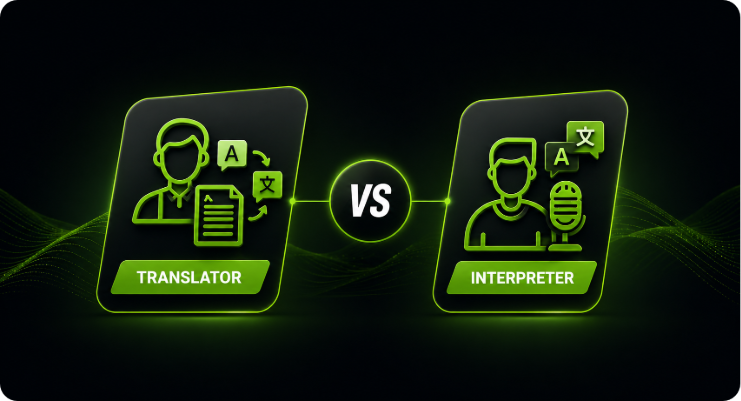
An interpreter converts spoken language from one language to another in real time. Their primary goal is to facilitate communication between people who speak different languages.
Interpreters are commonly used during:
• Business meetings
• Conferences and events
• Legal proceedings
• Medical appointments
• Live broadcasts
• International negotiations
Because interpretation happens instantly, interpreters must listen, process information, and deliver accurate speech within seconds. Strong concentration, quick thinking, and excellent verbal communication skills are essential.
What Does a Translator Do?
A translator works with written content, converting text from one language into another while preserving its original meaning, tone, and context.
Translation services are commonly used for:
• Websites
• Marketing materials
• Contracts and legal documents
• Technical manuals
• E-learning content
• Books and publications
• Subtitles and captions
Unlike interpreters, translators typically have more time to research terminology, verify context, and refine wording to ensure the highest level of accuracy.
Key Differences Between Interpreters and Translators
Communication Medium
The biggest difference lies in the type of communication they handle.
Interpreters work with spoken language, while translators work with written content.
Delivery Method
Interpretation occurs in real time during conversations, presentations, or events.
Translation is completed before publication or distribution, allowing for editing and quality review.
Language Direction
Interpreters usually translate information immediately between two languages during live communication.
Translators carefully convert written text while maintaining linguistic accuracy and cultural relevance.
Accuracy Requirements
Both professions require precision, but translators generally have more time to review and perfect their work.
Interpreters must prioritize accuracy while simultaneously keeping pace with live conversations.
Skills and Expertise
Successful interpreters need:
• Active listening skills
• Excellent memory retention
• Fast decision-making abilities
• Strong verbal communication
• Cultural awareness
Successful translators require:
• Exceptional writing skills
• Research capabilities
• Subject-matter expertise
• Attention to detail
• Deep understanding of grammar and style
Work Environment
Interpreters often work on-site or remotely during live events, meetings, and conferences.
Translators typically work on documents, websites, media content, and digital assets from a structured workflow.
Similarities Between Translation and Interpretation
Although they operate differently, translation and interpretation share several important characteristics.
Both services:
• Facilitate multilingual communication
• Require fluency in multiple languages
• Demand cultural understanding
• Prioritize accuracy and context
• Help organizations expand internationally
Whether spoken or written, the ultimate goal remains the same: delivering a message clearly and effectively to the target audience.
Which Service Do You Need?
The right choice depends on your communication needs.
Choose interpretation services if you need real-time language support for conversations, meetings, events, or live presentations.
Choose translation services if you need written content adapted for a new audience, including documents, websites, marketing materials, subtitles, or captions.
Many global organizations rely on both services to ensure seamless communication across different markets and languages.
Final Thoughts
Interpreters and translators both play an essential role in breaking language barriers, but their responsibilities are distinctly different.
Interpreters specialize in converting spoken language during live interactions, while translators focus on adapting written content with accuracy and cultural relevance.
Understanding these differences allows businesses to select the right language solution, improve communication, and confidently connect with international audiences.
At CaptioFlow, we help organizations communicate globally through professional translation, interpretation, subtitling, and localization services, ensuring every message reaches the right audience with clarity and precision.
Leave A Comment