
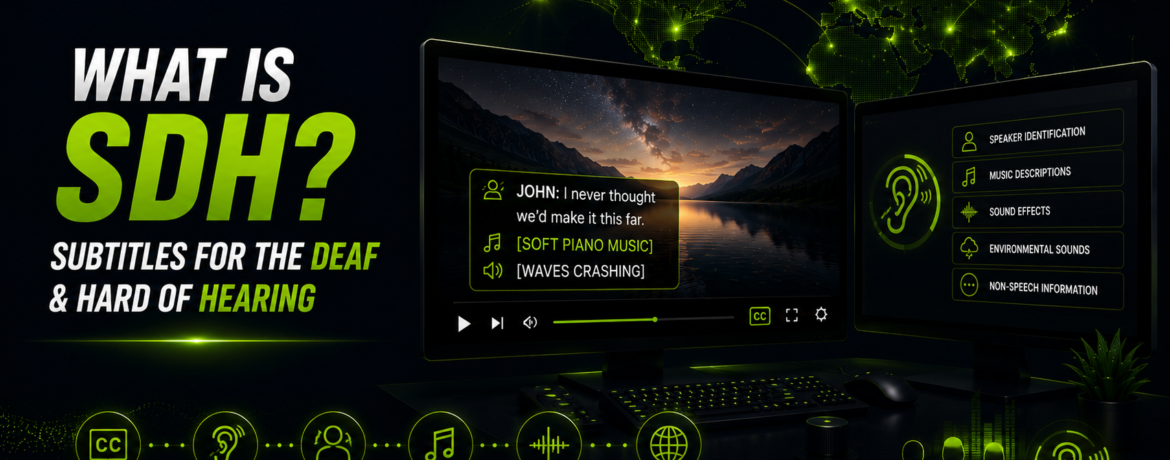
What Is SDH (Subtitles for the Deaf and Hard of Hearing)? The Complete Guide
Estimated Reading Time: 9 Minutes
Last Updated: June 2026
Quick Summary
Subtitles for the Deaf and Hard of Hearing (SDH) are designed to make video content accessible by combining spoken dialogue with important audio information such as speaker identification, sound effects, and music descriptions. Unlike standard subtitles, SDH provides a complete viewing experience for audiences who cannot rely on audio alone. This guide explains what SDH is, how it differs from subtitles and closed captions, where it is used, and why it has become an essential part of modern media production.
Table of Contents
1. What Is SDH?
2. Why SDH Matters
3. How SDH Differs from Standard Subtitles
4. SDH vs Closed Captions
5. Where SDH Is Used
6. Essential Elements of Professional SDH
7. Best Practices
8. Frequently Asked Questions
9. Conclusion
Introduction
Imagine watching a suspense movie with the sound turned off. You can read every line of dialogue through standard subtitles, but you have no idea that footsteps are getting closer, thunder is rumbling outside, or dramatic music is building tension before an important scene. Those missing audio cues can completely change how a story is understood.
This is exactly the challenge that Subtitles for the Deaf and Hard of Hearing (SDH) are designed to solve. Rather than displaying dialogue alone, SDH communicates the full audio experience by describing important sounds, identifying speakers, and providing context that hearing audiences naturally receive through sound.
As accessibility becomes a priority across streaming platforms, broadcasters, educational institutions, and corporate media, SDH has evolved from a niche requirement into an industry standard. Whether you’re distributing a feature film, an online course, or a marketing campaign, understanding SDH is essential for creating inclusive and professional video content.
What Is SDH?
SDH stands for Subtitles for the Deaf and Hard of Hearing. It is a specialized form of subtitling that combines spoken dialogue with meaningful non-verbal audio information to ensure viewers who cannot hear the soundtrack still receive the complete context of a scene.
Unlike standard subtitles, which usually assume the audience can hear background audio, SDH provides additional descriptions whenever sound contributes to understanding the story or message.
A professional SDH file may include:
• Speaker identification
• Sound effects
• Music descriptions
• Emotional tone
• Environmental sounds
• Off-screen dialogue
These additional details help viewers follow conversations, understand scene transitions, and experience emotional moments that would otherwise be communicated only through sound.
Why SDH Matters
Accessibility is no longer viewed as an optional feature. It has become an essential part of creating high-quality video content that serves diverse audiences.
According to global accessibility best practices, providing accessible video content allows organizations to communicate more effectively with people who are deaf or hard of hearing while also benefiting viewers in sound-sensitive environments.
Professional SDH offers several important advantages.
• Creates an inclusive viewing experience.
• Improves accessibility for hearing-impaired audiences.
• Supports multilingual distribution.
• Enhances educational content.
• Improves comprehension during complex scenes.
• Meets accessibility expectations for many platforms.
Beyond accessibility, SDH also benefits viewers who watch videos in offices, airports, libraries, or on public transportation where audio may be unavailable.
How SDH Differs from Standard Subtitles
At first glance, SDH and standard subtitles may appear nearly identical. Both display dialogue on screen, but their purpose and level of detail are significantly different.
Standard subtitles focus primarily on translating or displaying spoken dialogue. SDH goes several steps further by representing meaningful sounds that contribute to the viewer’s understanding.
| Feature | Standard Subtitles | SDH |
|---|---|---|
| Dialogue | ✔ | ✔ |
| Speaker Identification | Usually No | ✔ |
| Sound Effects | ✘ | ✔ |
| Music Descriptions | ✘ | ✔ |
| Environmental Sounds | ✘ | ✔ |
Think of SDH as translating the entire audio experience rather than just the spoken words.
SDH vs Closed Captions
One of the biggest misconceptions in media production is that SDH and closed captions are exactly the same. Although they share many similarities, they are delivered differently and are often used in different production workflows.
Closed captions are traditionally associated with accessibility within the same language and can usually be turned on or off by the viewer. SDH, on the other hand, is commonly used within subtitle workflows, especially for streaming services and multilingual content.
| Feature | Closed Captions | SDH |
|---|---|---|
| Accessibility | ✔ | ✔ |
| Speaker Identification | ✔ | ✔ |
| Sound Descriptions | ✔ | ✔ |
| Subtitle Workflow | Limited | ✔ |
| Multilingual Support | Sometimes | ✔ |
In many modern streaming workflows, SDH has become the preferred solution for combining accessibility with multilingual subtitle delivery.
Where Is SDH Commonly Used?
As accessibility standards continue to evolve, SDH has become an essential requirement across a wide range of industries. It is no longer limited to television broadcasts. Today, streaming platforms, educational institutions, corporations, and public organizations rely on SDH to make their video content accessible to broader audiences.
Organizations commonly use SDH for:
• Feature films
• Television series
• Streaming platforms
• Corporate training videos
• E-learning courses
• Government communications
• Healthcare education
• Marketing campaigns
• Product demonstrations
• Webinars and virtual events
• Documentaries
• Public information videos
As more businesses adopt video-first communication strategies, SDH helps ensure that content remains inclusive regardless of where or how it is viewed.
The Essential Elements of Professional SDH
Creating effective SDH involves much more than adding extra text to subtitles. Every element should improve understanding without overwhelming the viewer.
Speaker Identification
Whenever it may not be immediately obvious who is speaking, SDH identifies the speaker. This becomes particularly important during off-screen dialogue, interviews, documentaries, or scenes involving multiple people.
Example:
[Emma]: We need to leave now.
[Narrator]: The investigation continued for months.
Sound Effects
Many sounds contribute directly to the story. Professional SDH includes only meaningful sound effects that help viewers understand the scene.
Examples:
• [Door slams]
• [Glass shatters]
• [Phone ringing]
• [Crowd applauding]
Music Descriptions
Music often establishes emotion or signals important moments in a story. Instead of naming every song, SDH describes the mood or purpose when relevant.
Examples:
• [Soft piano music]
• [Suspenseful orchestral music]
• [Upbeat pop music playing]
Environmental Sounds
Some scenes rely heavily on background sounds to communicate context. Rain, explosions, traffic, or approaching footsteps can all influence how a viewer interprets the action.
Only sounds that contribute to the narrative should be included, while insignificant ambient noises are generally omitted.
Professional SDH Best Practices
High-quality SDH should feel natural, easy to follow, and consistent throughout the video. Professional subtitle specialists follow established guidelines to balance readability with accessibility.
Recommended best practices include:
• Synchronize subtitles accurately with dialogue and meaningful sounds.
• Keep subtitle durations comfortable for reading.
• Limit subtitles to two lines whenever possible.
• Use natural sentence breaks.
• Maintain consistent terminology and formatting.
• Clearly distinguish different speakers.
• Describe only sounds that contribute to understanding the scene.
• Perform thorough quality control before delivery.
Common SDH Formatting Guidelines
Although requirements vary between platforms, professional SDH projects generally follow several widely accepted formatting principles.
| Guideline | Recommended Practice |
|---|---|
| Maximum Lines | Two lines |
| Reading Speed | Comfortable for average viewers |
| Speaker Identification | Only when necessary |
| Sound Descriptions | Meaningful and concise |
| Formatting | Consistent throughout the project |
| Quality Control | Mandatory before delivery |
Following consistent formatting improves readability while helping subtitles meet broadcast and streaming requirements.
Frequently Asked Questions
What does SDH stand for?
SDH stands for Subtitles for the Deaf and Hard of Hearing. It combines spoken dialogue with important audio information such as speaker identification, music descriptions, and sound effects.
Is SDH the same as closed captions?
They are very similar and both improve accessibility, but SDH is commonly used within subtitle workflows and multilingual content distribution, while closed captions are traditionally associated with accessibility in the original language.
Do streaming platforms support SDH?
Yes. Many major streaming services support SDH as part of their accessibility offerings, although formatting and delivery specifications may vary between platforms.
Why can’t standard subtitles replace SDH?
Standard subtitles generally display only spoken dialogue. They usually omit important audio information that viewers who cannot hear the soundtrack need in order to fully understand the content.
Can AI generate SDH automatically?
AI can assist with transcription and draft subtitle creation, but professional SDH still requires human review to ensure accurate speaker identification, meaningful sound descriptions, natural timing, and consistent formatting.
Conclusion
Subtitles for the Deaf and Hard of Hearing play a vital role in making modern video content accessible, engaging, and inclusive. By combining dialogue with meaningful audio descriptions, SDH allows viewers who cannot rely on sound to experience the same information and emotional context as hearing audiences.
As video continues to dominate communication across entertainment, education, business, and digital marketing, investing in professionally produced SDH is no longer simply about compliance. It demonstrates a commitment to accessibility, improves audience engagement, and helps organizations deliver content that reaches everyone.
Whether you’re producing a feature film, an online training course, a marketing campaign, or content for a global streaming platform, professionally created SDH ensures your message is communicated clearly and effectively.
Leave A Comment